

Statistics for Business Analytics: School of Business
Transforming Business School online learning and teaching from HE 2.0 to HE 4.0
The Challenge
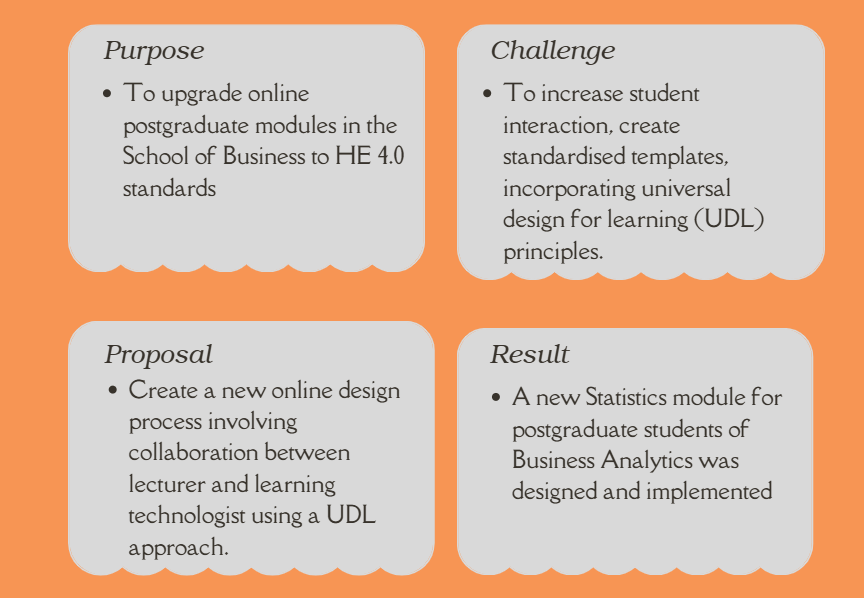
The module Statistics for Business Analytics is part of the Higher Diploma in Business Analytics. This Springboard-funded programme is targeted at postgraduate adult distance leaners.
The programme is entirely online and, in addition, almost entirely asynchronous. The asynchronous mode is very popular with the student cohort, offering flexibility in time.
The disadvantage of asynchronous mode is the constraint on learner interaction, a known requirement of good online learning (1). Student-content interaction is especially important in online, asynchronous learning.
The Solution
The standard content design for this programme involved a recorded PowerPoint lecture, student assignments and documentary reference material.
The design goal for this project was to replace PowerPoint lectures and pdf content with interactive lessons using Rise and H5P. Furthermore, the overall course was redesigned using a professional design approach incorporating UDL principles.
This was executed using a collaborative approach: lecturer and learning designer working together to produce weekly topic material.
The Result
The module was redesigned on a constructivist basis using tiles to present topics and a standardised layout of lessons, activities, assignments and supporting material.
The design team worked to re-format older material into learning objects combining exposition, reading, and learner activity.
- Learner no longer reported problems with lecture videos.
- Learner activity (Moodle activity reports) increased markedly.
- Ease of navigation around the module increased considerably with the new topic-based tiles and standard layout.
The primary project output was a completely re-designed module in a popular online course up to HE 4.0 standards
The secondary output was a template and a champion for propagating this re-design across the programme and into other online offerings.
The final output was an understanding of the importance and the challenges of the collaborative online design process, a pre-requisite for further expansion of the university’s online presence.
“Student-content interaction refers to students interacting with the subject matter under study to construct meaning, relate it to personal knowledge, and apply it to problem solving.” - M. G. Moore, Professor of Education, Pennsylvania State University
Appendix:
1 Abrami, P.C., Bernard, R.M., Bures, E.M. et al. Interaction in distance education and online learning: using evidence and theory to improve practice. J Comput High Educ 23, 82–103 (2011). https://doi.org/10.1007/s12528-011-9043-x

