
Case Study: Mentoring for Food Entrepreneurs
Mentorship fosters innovation and contributes to business growth and resilience, which are vital for the success and sustainability of the agri-food sector.
The agri-food sector plays a vital role in Europe's economic growth and ensuring food security. However, many entrepreneurs in the sector are small to medium-sized enterprises (SMEs) that struggle with limited access to resources, time, and expertise.
These challenges hinder their capacity to innovate, scale, and adopt sustainable practices, which are increasingly expected by consumers and policymakers (European Commission, 2021). Mentorship programmes are effective for business growth and innovation, yet many entrepreneurs are unaware of their potential.
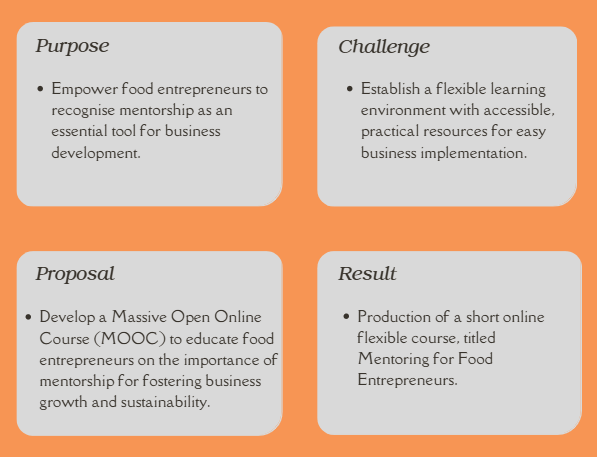
The project aimed to develop a Massive Open Online Course (MOOC) to educate food entrepreneurs on how mentorship can accelerate their growth, foster innovation, and improve sustainability practices.
The MOOC should equip entrepreneurs with free, accessible, innovative education and resources to foster creative thinking and encourage participation in mentorship programmes.
The Challenge
Food entrepreneurs face unique challenges, including navigating regulatory frameworks, adopting sustainable practices, and keeping pace with technological advances. These businesses often lack the time and financial resources for traditional upskilling programmes (Smith, 2021).
Mentorship provides a cost-effective solution, offering personalised guidance and support. However, many entrepreneurs are unaware of how to find and engage the right mentor, which can limit their growth potential.
The challenge in this project is to establish a flexible learning environment that assists food entrepreneurs in identifying and engaging the right mentor and mentoring programme.
The Solution
To develop a MOOC as an innovative and flexible learning approach that allows learners to engage in self-guided study at their own pace.​
Create interactive learning resources to educate entrepreneurs on how mentorship can enhance their growth, promote innovation, and improve sustainability practices.​
The lessons will incorporate work-based learning, evaluation and practical activities.​
A blend of theoretical content and video resources will be used, complemented by reflective exercises to help learners assess their understanding and track their progress.

The Result
The Mentoring for Food Entrepreneurs MOOC was developed to provide food entrepreneurs with accessible and flexible learning. A MOOC format was chosen to ensure that SMEs in rural and remote areas could access essential knowledge and resources.
The course allows entrepreneurs to learn at their own pace, addressing the common challenge of time constraints in the sector. Designed with interactive technology and resources, the course accommodates various learning styles.
The lessons emphasise practical skills and real-world application, empowering entrepreneurs to apply concepts, engage actively, and identify the right mentor and mentoring programme for their needs.
The MOOC includes four learning sessions, each with specific outcomes. Embedded evaluations and practical activities in each session help learners monitor their comprehension.
Feedback
Feedback from food entrepreneurs during the MOOC development consultation was highly positive, with most recognising the crucial role mentorship can play in sustaining the food sector.
“Mentors provide a different perspective to the business, offer guidance and support and can lead to better problem solving.”
“A mentorship programme also offers extensive networking and collaborative opportunities.”
“Mentors draw from their own experience and expertise to help navigate challenges and inspire creative thinking and innovation.”

