
Case Study: Smart Agri Remote Lab
The agriculture sector in Ireland is currently facing a significant shortage of professionals skilled in smart agriculture technologies and sustainability practices. This gap hinders the industry’s ability to adopt innovative solutions, optimise resource use, and contribute to sustainable food production and environmental conservation.
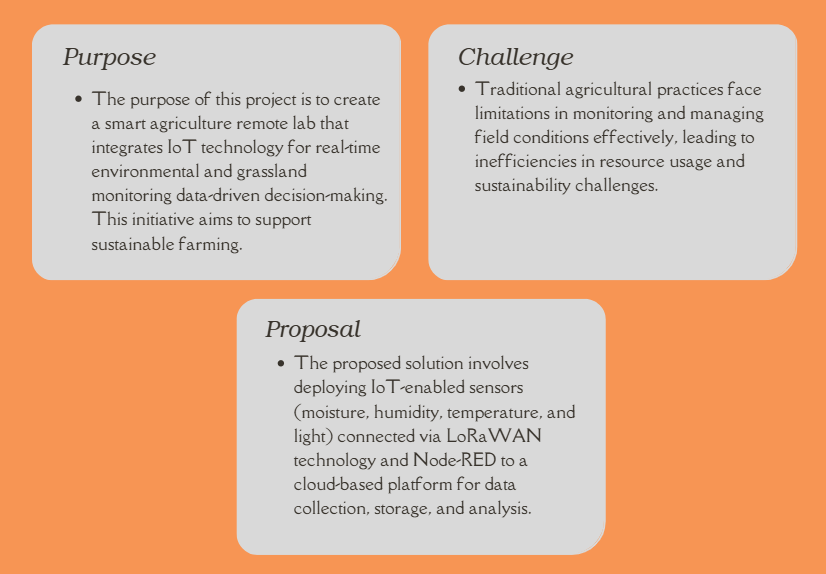
This project focuses on integrating Internet of Things (IoT) technology with smart agriculture to enhance sustainability and efficiency. It utilises sensors (moisture, humidity, temperature, and light) and LoRaWAN communication for real-time environmental monitoring and data-driven decision-making. The solution aims to optimise resource use, improve crop yields, and support sustainable farming practices.
The Challenge
The purpose of this project was to develop a remote lab for smart agricultural systems, leveraging Internet of Things (IoT) technology. The initiative aims to enable efficient data capture, storage, and analysis to enhance agricultural productivity. This includes field-based sensing using soil and weather sensors and the deployment of an intelligent gateway to facilitate Machine-to-Machine (M2M) and Machine-to-Cloud (M2C) communication
Traditional agricultural monitoring systems are limited in their ability to collect and analyse real-time data across vast areas. This limitation hinders predictive decision-making, sustainability practices, and the optimisation of resources. The challenge was to create a scalable and cost-effective solution for data-driven agriculture using advanced IoT technologies.
The Solution
To address the challenges of traditional agricultural systems, the proposed solution integrates advanced IoT technologies into a smart agricultural remote lab.
Field Capture and Sensing: Soil and weather sensors are deployed to collect environmental data in real time in the field.
- Intelligent Gateways: The SenseCAP Gateway, operating on the LoRaWAN EU868 protocol and 4G, ensures robust communication between field sensors and the centralised cloud platform.
- Cloud Integration: Data captured is transmitted using MQTT protocols to a cloud platform, allowing secure storage and real-time access for analytics and decision-making.
- Data Analytics and Machine Learning: The system incorporates machine learning models using Node-RED to analyse trends, anomalies, and provide actionable insights to optimise agricultural productivity using Node-RED framework.
The Result
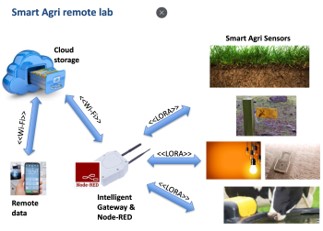
The integration of moisture, humidity, temperature, and light sensors with the SenseCAP Gateway delivered exceptional results in monitoring agricultural environments. The sensors provided real-time, accurate data on critical parameters, enabling better understanding and control of field conditions. LoRa technology stood out for its long-range, low-power capabilities, achieving reliable communication over – distances up to 10km in open fields and 2 km in urban areas.
The LoRaWAN protocol ensured low-power, robust data transmission with mutual authentication and encryption. This technology was easy to deploy using the SenseCAP Mate App and Cloud Portal, enabling rapid scalability for broader applications. Data analysis, performed using AI within the Node-RED framework, provided actionable insights to optimise irrigation schedules and improve crop yields.
The durable, industrial-grade design ensured reliable performance even in harsh environments over long time periods, making this solution a powerful example of how IoT and LoRa technology can revolutionise smart agriculture.
“It’s a very hands-on experience for students to see the equipment in the environment and not just slides on the topic; thanks to this new equipment students graduate with real world experience in the application and operation of these state-of-the-art tools.” - Stephen Foy, lecturer Robotics and Automation, ATU Galway
