
ATU Agricultural Engineering Students Master Smart Agri Systems
Remote labs, funded by Higher Education 4.0, support teaching of modern agricultural practices.
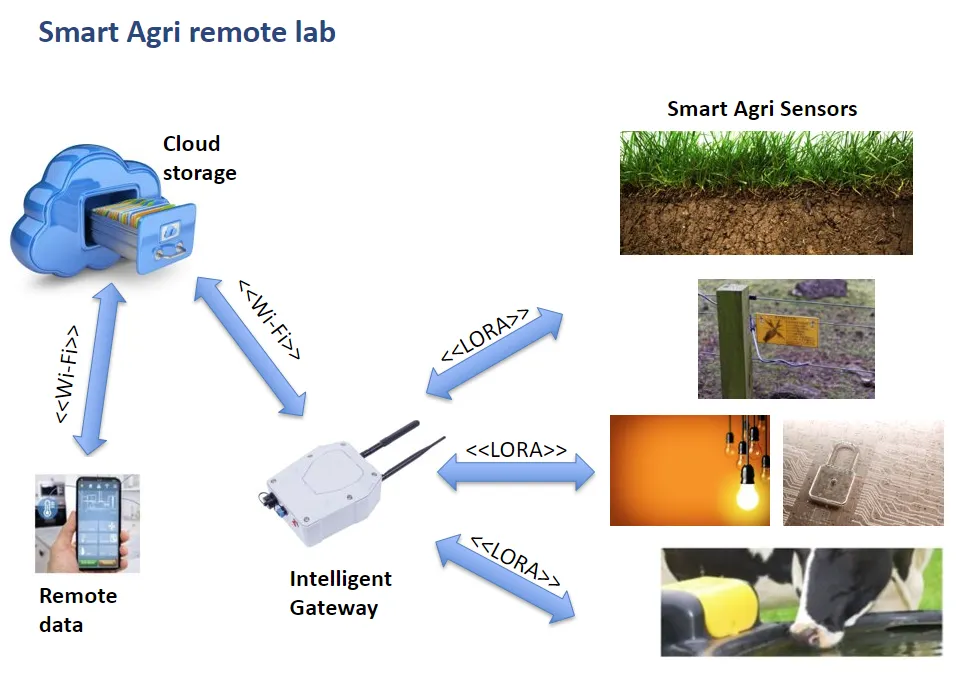
ATU Agricultural Engineering students have been learning how remote agricultural sensors play a crucial role in modernising and optimising agricultural practices. Students have gained ‘hands-on’ experience in seeing how remote labs enable precision agriculture by providing real-time data on various parameters such as soil moisture, temperature, humidity, nutrient levels, and crop growth.
How does it work?
Remote sensors collect a wealth of data from across the farm, providing insights into the variability of different factors. This data helps farmers make informed decisions about planting, harvesting, and other critical activities. It also facilitates predictive modelling to anticipate potential issues and plan accordingly. With accurate and timely data, farmers can optimise the use of resources like water, fertilisers, and pesticides. This reduces waste and environmental impact while improving the economic viability of the farm.
Remote sensors can also generate data that can be integrated with other agricultural technologies such as GPS-guided machinery and autonomous drones. This synergy enhances the overall efficiency and effectiveness of farming operations. In an era of increasing consumer demand for transparency, remote sensors can help farmers maintain accurate records of their practices. This is especially important for meeting regulatory standards and demonstrating the sustainability of their operations.
Higher Education 4.0 has funded The Remote Lab Project, which is a self-contained remote agri sensor unit. This project kit can physically be taken to a sports field or agriculture location to capture data such as air temperature and moisture, soil temperatures and moisture, light levels and also grass health.
The unit is solar powered and can be buried underground, greatly enhancing its longevity. Students will learn how to build their own units and also how to use the units for data modelling.
Stephen Foy, lecturer Robotics and Automation, says: “It’s a very hands-on experience for students to see the equipment in the environment and not just slides on the topic. Thanks to this new equipment students will graduate with real world experience in the application and operation of these state-of-the-art tools.”
For course details, go to: www.atu.ie/courses/bachelor-of-engineering-honours-agricultural-engineering.
